Tracking psilocybin sessions reveals patterns no single trip can show. Dose, strain, set, and setting — here's what your own session logs will teach you.
Most conversations about psilocybin harm reduction focus on the session itself — dose, set, setting, a trusted sitter. Those variables matter enormously. But there is a layer of safety infrastructure that almost no guide discusses: what you do after the session, and how you connect that session to the ones before it.
Trip journaling is that layer. And the evidence — both from the clinical literature and from what experienced researchers reliably report — suggests it may be as important as any pre-session preparation.
Human memory of altered states is unreliable in specific, predictable ways. The emotional salience of a psilocybin experience tends to compress the experiential timeline: a five-hour session might feel like ninety minutes at the time, and the details that felt most vivid at peak — the exact wording of an insight, the sequence of emotional states, how long the onset actually took — are typically the first to degrade.
Within 48 hours of a session, most people retain the emotional gestalt (profound, difficult, joyful, frightening) but lose the granular data that would make that session genuinely useful for calibrating the next one. Within a week, even the gestalt has softened.
This matters for one reason above all others: dose calibration is an iterative process, and iteration requires accurate prior data.
If you took 2g of Golden Teacher six weeks ago and it felt underwhelming, your decision about the next session depends on remembering that clearly. Did it feel underwhelming because the dose was too low, because your tolerance was elevated from a session two weeks prior, because you ate a heavy meal beforehand, or because the set and setting actively suppressed the experience? Without a record, those variables collapse into a single vague memory.
A journal separates them.
The clinical psilocybin research — from Griffiths et al. at Johns Hopkins, Carhart-Harris et al. at Imperial College London, and the ongoing trials at NYU and MAPS — consistently identifies integration as a primary mediator of therapeutic outcome.
Integration, in clinical terms, refers to the process of consciously connecting insights from a session to ongoing life. In the NYU 2016 psilocybin cancer study (Ross et al., J. Psychopharmacology), participants who showed the largest reductions in anxiety and depression scores were those who engaged most actively with post-session processing — reviewing what arose, connecting it to their history, and building a narrative around it.
The Imperial College group's 2017 landmark study on treatment-resistant depression (Carhart-Harris et al., Lancet Psychiatry) found that participants who could articulate specific insights from their sessions — rather than just reporting a vague positive shift — maintained improvements significantly longer at six-month follow-up.
What those participants were doing, in effect, was journaling. Writing down what arose. Revisiting it. Asking: what changed, and why?
The integration window — roughly 24 to 72 hours post-session, when neuroplasticity markers remain elevated — is when this work matters most. Writing in that window is not just meaningful; it may be pharmacologically timed to stick.
Not everything from a session is worth writing down. But five variables, tracked consistently, generate the kind of longitudinal dataset that actually teaches you something.
Tryptamine content varies roughly 7× across common P. cubensis cultivars — from around 0.3% in low-expression phenotypes to over 2.0% in verified high-potency strains like Penis Envy. Preparation method compounds that variance: lemon tek increases peak intensity substantially by pre-converting psilocybin to psilocin before ingestion; tea reduces nausea but alters absorption kinetics; dried whole is the baseline.
If you don't record which strain you used and how you prepared it, you have no way to distinguish a "strong session" caused by elevated strain potency from one caused by lemon tek amplification from one caused by genuine increased sensitivity. Those three have different implications for your next session.
The shroomDOSAGE journal logs both fields — strain and preparation — alongside every entry. After several sessions, a pattern becomes visible: maybe you consistently rate dried Penis Envy sessions higher than lemon tek Golden Teacher at the same nominal gram count. That's information you couldn't have without the record.
Eyeballed doses introduce compounding error. A gram of dried mushrooms can look radically different depending on how densely packed the caps are, whether it's crumble or whole fruiting bodies, and how dry the batch actually is. A digital scale with 0.01g precision costs under $20 and eliminates an entire category of variance.
Log the gram weight every time. Over four or five sessions, you'll see whether your optimal range is genuinely 2.5–3g or whether you've been drifting between 1.8g and 3.4g and calling it all "three grams."
These terms come from Timothy Leary's original formulation and have been robustly validated by the clinical literature. Set refers to mindset at the time of ingestion — mood, intention, emotional state going in. Setting refers to physical and social environment.
The key insight the research confirms is that these variables are not just background context — they are active modulators of the experience. A session at home alone produces a systematically different experience than the same dose in a social setting, even with identical strain and preparation. Griffiths' 2006 foundational study (J. Psychopharmacology) showed that set and setting predicted mystical experience scores as strongly as dose tier.
Track both. After ten sessions, you'll know your optimal environment — and you'll be able to correlate the "this went sideways" sessions with specific setting characteristics.
The emotions present during a session are not random. They correlate with intention, with prior mental state, and with dose. Logging them — even just selecting from a list of tags like Joyful, Reflective, Heavy, Insightful, Difficult, Connected — builds a vocabulary for your own response profile.
One pattern that frequently emerges in committed journalers: certain mood states consistently precede difficulty. Logging "Anxious" as a pre-session mood tag three times before three sessions that went poorly is a data point. It suggests that anxiety at ingestion — regardless of dose or strain — is a reliable predictor of a challenging experience for that individual. That's actionable.
This is the field most people skip. It is also the most clinically significant.
The next-day window — after the acute effects have fully resolved and the nervous system has had a night of sleep — is when many researchers report their clearest integration insights. The session's emotional contents have settled enough to be examined; the neuroplasticity window is still open; the usual cognitive defences haven't fully reconstructed.
What changed? What came up that you didn't expect? What do you want to do differently next time — in life, not just in the next session?
Write it down. Even three sentences. The shroomDOSAGE journal has a dedicated Integration / Insights field specifically for this next-day entry — it's intentionally separate from the trip notes to mark the temporal and cognitive distinction between what happened during the session and what you think about it the day after.
Psilocybin tolerance develops rapidly and resets slowly. A single moderate-to-high dose creates near-complete cross-tolerance lasting approximately 24–48 hours; partial tolerance typically persists for 7–14 days. Most harm reduction guidelines recommend a minimum two-week gap between sessions.
In practice, tolerance is highly variable between individuals — some people reset closer to one week, others need three. The only way to know your personal reset window is to track when you dosed and correlate that with reported session intensity.
If you log date, dose, and experience rating consistently, you can test this directly: do sessions spaced two weeks apart feel equivalent to sessions spaced three weeks apart at the same dose? Or do you notice a consistent intensity ceiling when you're still within 14 days? After ten to fifteen data points, the pattern is usually clear.
Underdosing because of unrecognised residual tolerance is the most common reason people report "weak" sessions after their first few. Overdosing because of a longer-than-expected tolerance reset is the most common reason experienced users report unexpectedly intense sessions. Both are preventable with a record.
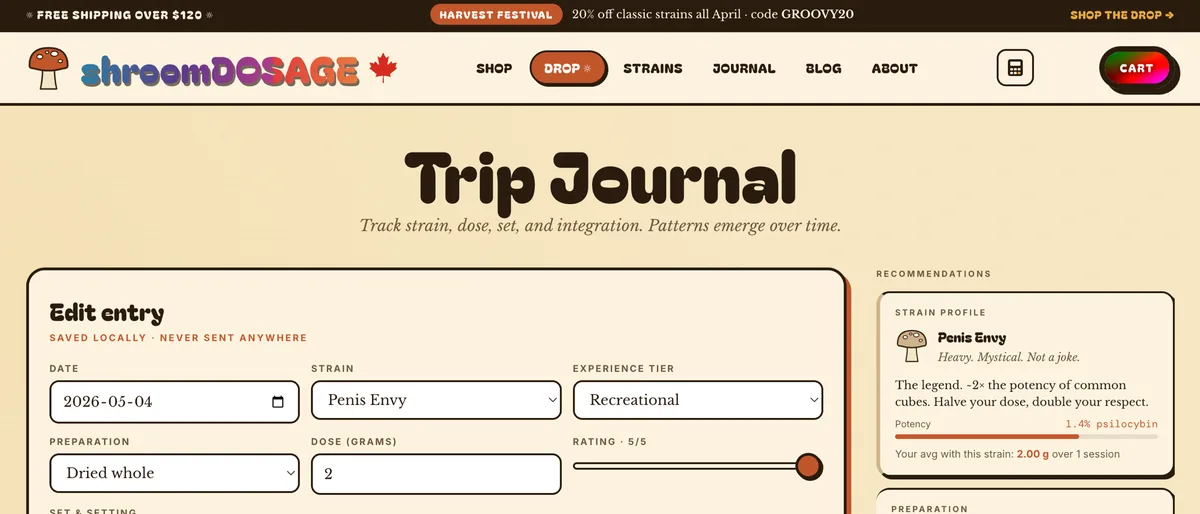
The shroomDOSAGE journal is built specifically for this kind of tracking. Every field maps directly to a variable the research identifies as meaningful: strain and preparation, gram dose, experience tier, set and setting, intention, mood tags during the experience, and a separate integration field for next-day reflections.
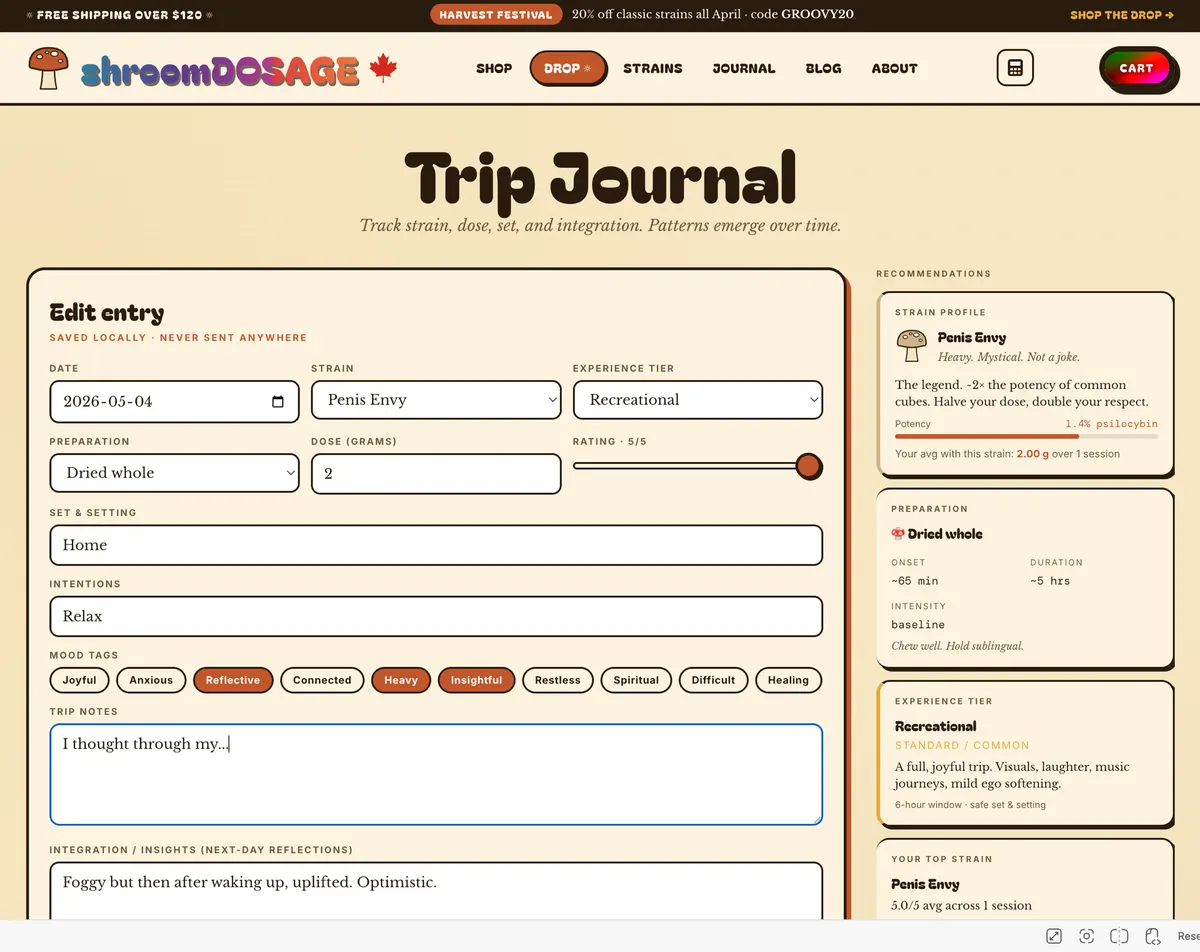
The sidebar surfaces contextual information alongside each entry: strain potency percentage, preparation onset and duration, and experience tier description. After a few sessions, the sidebar analytics show your average dose per strain and your most-used strains — pattern recognition that would otherwise require manual spreadsheet work.
Consider this session from the journal:
Standalone, this is one data point. With five similar entries, you start to see something: Penis Envy at 2g, dried whole, at home, produces a consistently heavy + insightful emotional profile and a reliable post-sleep positive shift. That pattern — heavy during, uplifted after — is characteristic of the strain and the dose tier. Knowing it in advance changes how you approach the session (you don't interpret heavy as bad; you know it's typically followed by clarity), and it changes how you dose the next time (2g is working; there's no reason to push to 2.5g).
The sidebar's recommendation engine in the shroomDOSAGE journal surfaces exactly this kind of pattern automatically: your average dose with this strain, your top-rated strain, and contextual preparation notes. After a few entries, it starts functioning as a personal data layer rather than a blank form.
There is one reason people don't journal psilocybin sessions that every other point in this article cannot overcome: fear of the record existing.
That fear is rational. Psilocybin is a controlled substance in most jurisdictions, including Schedule III in Canada under the CDSA. A detailed log of doses, strains, and sessions is exactly the kind of document you should never store in a cloud service, email, or any app that processes data server-side.
The shroomDOSAGE journal solves this at the architecture level. All data is stored in your browser's local storage — IndexedDB — which is local to your device and never transmitted. The sidebar analytics (pattern recognition, strain averages, tolerance alerts) are computed locally in your browser. No entry text, strain data, dosage information, or mood tags ever leave your device. There is no account, no server, no cloud sync.
The journal prominently displays "SAVED LOCALLY · NEVER SENT ANYWHERE" on every entry form. That's not marketing language — it's a factual description of the data architecture.
If you're journaling on paper because you don't trust digital tools, a browser-local journal is functionally equivalent from a privacy standpoint while being significantly more useful for pattern analysis.
If you've never journaled a session before, this is a sustainable starting protocol:
Before the session (5 minutes): Log the date, strain, preparation method, and dose. Add one sentence for set and setting ("at home, familiar space, alone") and one sentence for intention ("processing the thing from last month"). Select mood tags that match your current state.
During or immediately after (while still present): A few sentences in the trip notes field. Don't worry about coherence. Voice memos transcribed later are also fine — the key is capturing raw material while it's fresh.
The next day (10 minutes): Return to the entry. Add to the integration field. What do you remember most clearly? What do you want to do with it? What changed, even slightly?
That's it. Three touchpoints, roughly fifteen minutes total. The pattern starts emerging around session five or six.
There is a compounding return to consistent journaling that isn't obvious from any single session. The value of the first entry is low — it's one data point with no comparison baseline. The value of the tenth entry is qualitatively different: you have a personal pharmacology dataset that no clinical trial will ever produce, because it's yours specifically — your body, your mental context, your environmental variables, your strain history.
At that point, you stop guessing and start knowing. You know your optimal dose range for recreational sessions. You know which strain produces the emotional profile you're looking for. You know how long your tolerance reset takes. You know which setting works and which one creates problems.
You have, in effect, done the homework that the research says predicts better outcomes: you've built a relationship between your sessions instead of treating each one as an isolated event.
That relationship is what integration actually means.
The shroomDOSAGE trip journal is free, browser-local, and requires no account. All data stays on your device. If you're starting a journaling practice, it's a reasonable place to begin.
About the author
D.Spora — Master Grower
Every article on shroomDOSAGE starts with primary sources — clinical trials, published assay data, peer-reviewed pharmacology. We translate the findings into plain English so you can understand what the science actually says, without needing a medical degree. Sources are cited inline. Nothing here constitutes medical advice.
Your cart is empty.
Browse the catalogue to add items.